All Products - Ortho-Seat Washers
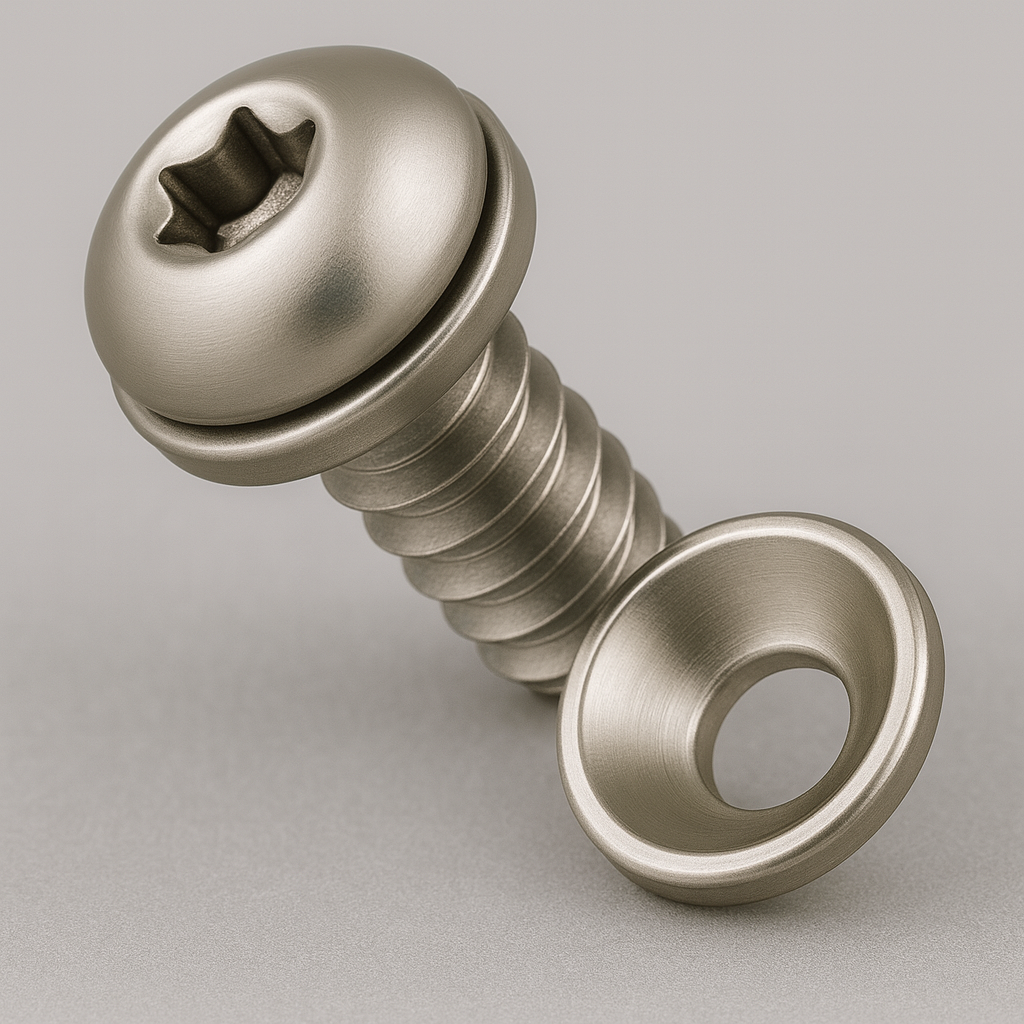
Ortho-Seat Washers
Price: $13.13
Product Info:
OrthoSeat Washer, 2.0 mm, Smooth | OSW-20 | $13.13
OrthoSeat Washer, 2.4 mm, Smooth | OSW-24 | $13.13
OrthoSeat Washer, 2.7 mm, Smooth | OSW-27 | $13.13
OrthoSeat Washer, 3.5 mm, Smooth | OSW-35 | $13.13
Email order to: sales@drmark.vet
Please include the following in your order email:
• Product name and size
• SKU number
• Quantity for each item
• Shipping address
• Contact name and phone number
Ortho-Seat Washers
Key Features & Benefits:
- Recessed Seating:
The unique concave design allows the screw head to nestle securely, providing a low-profile finish that significantly reduces post-operative soft-tissue irritation. - Superior Load Distribution:
Spreads axial forces over a broader surface area, ensuring stable interfragmentary compression and preventing cortical failure. - Optimized Stability:
Enhances the "purchase" of the screw, especially in metaphyseal or cancellous bone.
Description:
ORTHOSEAT WASHER
A Next-Generation Upgrade to the Washered Anchor Extracapsular Repair Technique
The Problem with Traditional Washers
- Traditional ECS washers are overly large and domed, crowding the surgical field.
- They restrict the ability to tension and crimp effectively.
- Increase suture abrasion and soft-tissue retraction.
- Create variability in stabilization quality.
The OrthoSeat Solution
- Engineered to match the OD (Outer Diameter) of AO cortical screw heads.
- Produces a compact, flat-seat profile that maintains the working corridor between anchors.
- Improves suture alignment and enhances construct reproducibility.
Key Features
- Flat-seat engineering for stable, uniform load distribution.
- Ultra-low-profile footprint for a clean, unobstructed surgical field.
- Preserves crimping corridor for easier, repeatable tensioning.
- Reduces soft-tissue trauma and closure complications.
- Integrates seamlessly into existing extracapsular workflows.
The Washered-Anchor Technique
- A modern refinement of the lateral extracapsular stabilization method.
- Uses a washered screw at the tibial quasi-isometric point and either a fabellar or femoral anchor to reproduce isometric tensioning and predictable stabilization across flexion-extension.
Technical Specifications
| Screw Size | Screw Head OD | OrthoSeat Target OD |
|---|---|---|
| 2.0 mm | 4.0 mm | 4.1 mm |
| 2.4 mm | 4.0 mm | 4.1 mm |
| 2.7 mm | 5.0 mm | 5.1 mm |
| 3.5 mm | 6.0 mm | 6.1 mm |
Distributor Advantages
- High-demand implant for both GP and orthopedic surgeons.
- Clean add-on product to sutures, crimps, and ECS kits.
- No learning curve with instant adoption.
- Strong repeat-purchase pattern.
- Complements TPLO and TTA product lines without competing.
Material & Durability:
- Crafted from medical-grade 316L Stainless Steel
- Bio-inert and corrosion-resistant
- Engineered for permanent internal fixation
ORTHOSEAT WASHER (WASHERED-ANCHOR TECHNIQUE)
SIMPLER. CLEANER. MORE REPRODUCIBLE RESULTS
Design Features
-
Designed to match the cortical screw head OD for a clean, ultra-low-profile footprint.
-
Flat-seat geometry provides a stable, uniform load-bearing surface—no dome, no rocking.
-
More room for tensioning and crimping between femoral and tibial anchors.
-
Reduced soft-tissue trauma and smoother closure due to compact design.
-
Maintains ideal suture glide path for consistent, repeatable stabilization.
Compatibility
Compatible with all standard AO cortical screws:
Compatibility Table
| Screw Size | Washer OD |
|---|---|
| 2.0 mm | 4.1 mm |
| 2.4 mm | 4.1 mm |
| 2.7 mm | 5.1 mm |
| 3.5 mm | 6.1 mm |
Clinical Benefits
-
Enhances construct stability by preventing suture cut-through.
-
Provides a more ergonomic tensioning angle, improving repeatability.
-
Supports cleaner, faster extracapsular procedures with fewer workflow frustrations.
-
Preserves the crimping corridor, improving suture alignment and tension control.
-
Delivers a simple, elegant improvement to a familiar technique—no learning curve.
Technique Title: Washered-Anchor Technique (ORTHOSEAT WASHER)
Step 1—Approach:
-
A routine lateral parapatellar incision is made.
-
The lateral fascia is reflected caudally to expose the lateral fabella and the caudolateral femoral condyle.
-
Meniscal inspection and any necessary debridement or release are performed prior to stabilization.
Step 2—Identify Isometric Points:
-
Experimental work confirms true isometric points do not exist, but quasi-isometric pairs provide minimal distance change during flexion and extension.
-
Femoral Isometric Point: Identified on the caudal edge of the femoral condyle adjacent to the cranial pole of the lateral fabella.
-
Tibial Isometric Point: Located just distal and caudal to the insertion of the patellar ligament, immediately caudal to Gerdy’s tubercle along the caudal edge of the tibial extensor groove.
Step 3—Implant Placement:
-
A washered cortical screw is placed at the tibial isometric point to prevent suture cut-through and distribute load evenly.
-
The suture line (monofilament nylon or UHMWPE like LigaFiba® or FiberWire®) is passed to the proximal anchor.
-
Proximal anchor options: The lateral fabella or a second washered screw at the femoral isometric point.
Step 4—Tensioning and Closure:
-
Tension is applied until the cranial drawer test is negative and tibial thrust is neutralized.
-
The suture is secured under the washers, maintaining consistent load without suture deformation.
Anchor Configurations:
|
Configuration Type |
Description |
|---|---|
|
Unilateral Anchors |
Femoral – Lateral Fabella / Tibial – Washered Anchor |
|
Bilateral Anchors |
Femoral – Washered Anchor / Tibial – Washered Anchor |
Intended Usage & Species:
- Indicated for canine and feline patients
- Used in TPLO (Tibial Plateau Leveling Osteotomy), corrective osteotomies, and complex long-bone fracture repairs
- Particularly beneficial when cortical thickness is a concern
Product Type: Veterinary Orthopedic Product
SKU: OSW-
Brand: Dr. Mark Vet
